
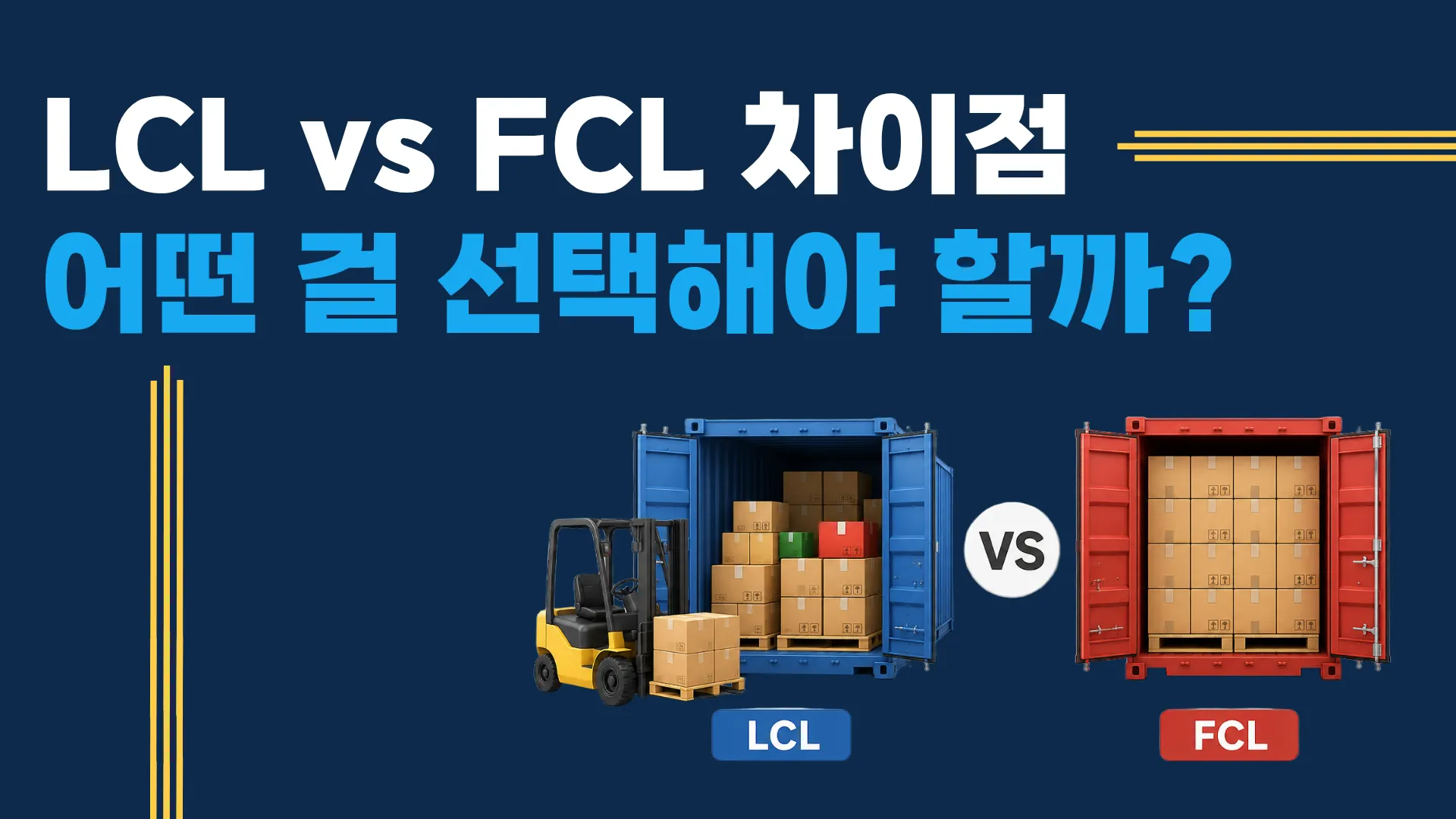
LCL vs FCL: The Complete Comparison —
Which Should You Choose?

"Small shipment, choose LCL. Large shipment, choose FCL" — true, but it's not the whole story. You need to look at the cost structure and lead time to actually know which option wins for your cargo.

LCL vs FCL sea freight

LCL and FCL — the Basics

LCL (Less than Container Load) combines cargo from multiple shippers who can't fill a full container into one shared container. Since you're sharing the container, you also share the cost.

FCL (Full Container Load) means renting an entire container for your cargo alone. Because you book a dedicated 20ft or 40ft container, the per-unit cost drops as your cargo volume grows.

CategoryLCLFCL
Rate basisPer CBM (volume) or weightPer container
Suitable volumeRoughly 1–10 CBM10 CBM and up
Lead time2–5 days longer than FCLComparatively faster
Cargo consolidationShared with other shippers' cargoExclusive use
Damage riskRelatively higherLower

Cost Structure — Where the Difference Comes From

LCL freight is calculated per CBM (cubic meter). For example, if the China-to-Korea LCL rate is $50/CBM, a 3 CBM shipment costs $150. On top of that, you'll pay CFS (container freight station) handling fees, documentation fees, and more.

FCL is billed per container. For a 20ft container from China to Korea, the typical rate runs $300–$600. If your cargo fills more than about 70% of the container, FCL is usually the clear winner.

💡 As a general rule, once your cargo exceeds about 10 CBM, it's worth checking FCL rates. That said, the exact break-even point shifts with the trade lane, season, and cargo type — always compare quotes side by side.

Lead Time Differences

FCL can ship as soon as your cargo is ready. LCL, on the other hand, has to wait for other shippers' cargo to consolidate at the CFS warehouse first. Plan for roughly 2–5 extra days versus FCL.

If you're working against a tight deadline, look at FCL or air freight before defaulting to LCL.

Choosing Based on Cargo Type

The nature of your cargo also matters. Precision equipment or glassware — anything shock-sensitive — carries more risk of damage during LCL consolidation, so FCL is the safer choice. Standardized boxed goods, on the other hand, are fine with LCL.

Dangerous goods, refrigerated/frozen cargo, and shipments needing special packaging are often restricted or excluded from LCL consolidation entirely — always confirm this in advance.

Let Tosome Logis Handle It

Figuring out whether LCL or FCL wins for your shipment isn't always obvious — it depends on volume, trade lane, deadline, and item type all together. Just tell Tosome Logis your cargo details, and we'll show you the estimated cost and lead time for both options side by side.

Cargo size (CBM or box count), origin, and destination — that's all we need. We'll take it from there.

Contact

Get in Touch

Leave your item, size, and destination
and we'll reply quickly with a custom quote.

Address
401, 3-gil 31, Dangmi-ro, Gyeyang-gu, Incheon, Korea
Send us an email

Terms of Service & Privacy Policy

1. Personal Information Collected and Collection Method

Tosome Logis (the "Company") collects the following personal information to provide services such as customer inquiries, quote requests, and shipping consultations.

  • Items collected: name, email, phone number, address, cargo information, and any other information provided by the customer
  • Collection method: direct input via the website inquiry form, email inquiries, phone consultations, etc.

2. Purpose of Collection and Use

  • Responding to inquiries and quote requests
  • Confirming cargo information and contacting customers to provide shipping services
  • Service-related notices and customer support
  • Improving logistics service quality and providing tailored guidance

3. Provision and Sharing of Personal Information

The Company does not disclose personal information to third parties without customer consent, except in the following cases.

  • When the customer has given prior consent
  • When required by law or requested by a government authority
  • When minimal information must be shared with partner carriers (FedEx, DHL, UPS, etc.) necessary to complete shipment

4. Retention and Use Period of Personal Information

ItemReason for RetentionRetention Period
Inquiry and consultation historyPreventing service confusion, dispute resolution3 months
Contract and payment informationAct on Consumer Protection in Electronic Commerce5 years
Log recordsProtection of Communications Secrets Act3 months

5. Procedure and Method of Destroying Personal Information

  • Paper documents: shredded or incinerated
  • Electronic files: deleted using methods that prevent recovery

6. Use of Cookies

The Company may use cookies to improve the site experience.

  • Purpose: visitor statistics, personalized content
  • Opt-out: browser settings > block cookies

7. Personal Information Manager

- Name: Hui-deok Ahn
- Contact: 23logis@naver.com
- Available: weekdays 9:00 AM – 6:00 PM (KST)

8. User Rights and How to Exercise Them

Customers may request to view, correct, or delete their personal information at any time. Requests are processed without delay after identity verification.

9. Security Precautions

  • Use a combination of letters and numbers in your password, and change it periodically.
  • Log out and close your browser after using shared or public devices.
  • Do not leave personal information on message boards, chat windows, etc.

10. External Reporting and Contact Points

📌 Effective Date

July 1, 2025

Weighing LCL vs FCL?
Ask Tosome Logis.
Send us your cargo details and we'll send a cost/lead-time comparison right away.
KakaoTalk