
 KO
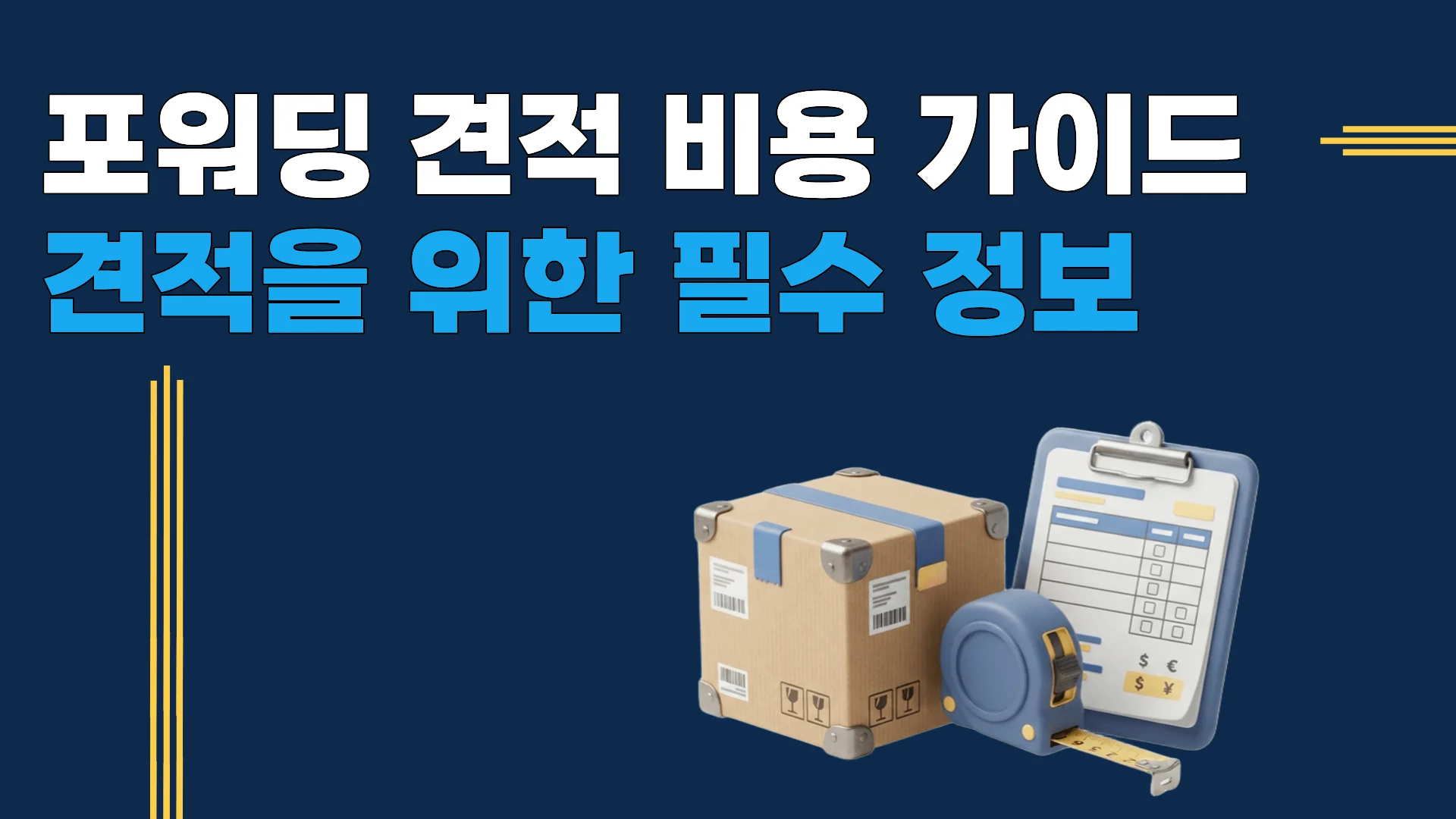
1. Why do China–Korea freight forwarding quotes vary so much?
Even for identical cargo on the same China–Korea route, quotes from different forwarders can vary widely. There's usually one reason: base ocean freight (O/F) is just the starting number — how much of the surcharge stack gets added on top, and how transparently it's disclosed, differs by forwarder.
It's the same structure as buying a plane ticket where the listed fare doesn't include the fuel surcharge or airport fees. If you don't understand the rate structure and simply pick the forwarder with the lowest headline freight, you can end up with unexpected charges once the cargo arrives in Korea — sometimes adding up to hundreds of dollars, occasionally over a thousand.
This guide walks through the base freight and surcharges that make up China freight forwarding rates, who's responsible for which cost under each Incoterm, and how to compare quotes accurately.
2. The basics of ocean freight — base rate and surcharges
Ocean freight on a China forwarding quote generally consists of two parts.
| Component | What it covers |
|---|---|
| Base rate (O/F, Ocean Freight) | Core sea transport cost, priced per container or by CBM (volume) |
| Surcharges | Additional charges layered on top of the base rate — driven by fuel prices, currency swings, container supply-demand, etc. |
Comparing forwarders on base rate alone is misleading. The China–Korea trade lane in particular carries more surcharge line items than many other routes, so a lower base rate doesn't always mean a lower total once surcharges are added.
3. Four surcharges that commonly go missing from quotes
Four surcharges show up especially often on the China–Korea lane. If a quote doesn't list any of these, treat it as a red flag that they may be missing, not included.
| Charge | Full name | Why it exists |
|---|---|---|
| BAF | Bunker Adjustment Factor | Offsets carrier losses from bunker fuel price fluctuations |
| CAF | Currency Adjustment Factor | Offsets currency exchange losses from settling freight in USD |
| LSS | Low Sulfur Surcharge | Covers the added cost of low-sulfur fuel required under environmental regulations |
| CIC (EIS) | Container Imbalance Charge | Offsets container supply-demand imbalance on a given trade lane |
These four charges aren't applied uniformly across every trade lane worldwide — whether they're charged, and how much, depends on the lane and the carrier. The China–Korea lane sees BAF, CAF and CIC especially often.
4. Who pays what under each Incoterm
In principle, which party bears these surcharges is determined by the Incoterm the shipment is contracted under.
| Charge type | F-terms (EXW·FOB·FCA) | C-terms (CFR·CIF) | D-terms (DAP·DDP) |
|---|---|---|---|
| Freight surcharges (BAF·CAF·LSS) | Importer pays | Exporter pays | Exporter pays |
| Destination charges (CIC, etc.) | Importer pays | Importer pays | Exporter pays |
That's the theory. In practice, charges like BAF, CAF and LSS are frequently billed late by the carrier after arrival at the import country, which is a common source of disputes between exporter and importer. It's especially common for importers to get stuck with these costs even under a C-term (CFR/CIF) contract where the exporter should technically be paying.
5. The full cost structure beyond ocean freight
A China forwarding quote doesn't stop at freight and surcharges. Once cargo reaches port, several more charges accumulate in sequence. Here's the typical full cost breakdown in practice.
| Cost item | When it applies | What it covers |
|---|---|---|
| Freight + surcharges (BAF·CAF·LSS·CIC) | At shipment | The base and surcharge items covered in sections 2–3 |
| THC (Terminal Handling Charge) | Origin & destination port | Terminal handling of container/cargo |
| CFS warehouse fee | Before/after loading | Consolidation/deconsolidation of LCL cargo into a container |
| D/O fee (Delivery Order) | On arrival | Fee for issuing the document needed to take delivery of cargo |
| Customs clearance fee | At clearance | Customs broker's fee for filing the import declaration |
| Duties & VAT | At clearance | Calculated from HS code and declared cargo value |
| Inland trucking | After clearance | Domestic delivery from port to final destination |
6. How to compare China–Korea freight forwarding quotes accurately
Understanding the rate structure doesn't help if a quote simply omits line items with no way to verify them. Use this checklist when comparing quotes.
7. What's different when you work with Tosome Logis
Tosome Logis discloses every surcharge in the China–Korea freight forwarding rate structure transparently, from the quote stage onward.
Send us your cargo type, quantity, and pickup or delivery location in China and Korea, and we'll lay out the full cost structure item by item.
 KakaoTalk
 Naver Blog